|
Linked to
La Pasión según la gente
(2000–2001), my first project in
Germany was
Mextoys. This work
represented a decisive
breakthrough in my practice. It
was my first fully realized
multimedia piece, and my first
work to integrate video and
music, music-theatre,
improvisation, and humor into a
single conceptual and structural
framework.
Mextoys was also the first
piece in which I consciously
focused on the idea of humans
as machines: as imitative
beings whose behaviors become
automated. In the piece, popular
Mexican street toys were used as
symbolic and material elements,
referring to early forms of
automated or robotic learning
produced through mass elementary
education systems. The title
Mextoys deliberately echoes
sex toys, alluding to the
mechanization of intimacy and
desire, and to the ways in which
human bodies and behaviors can
become programmed, standardized,
and instrumentalized.
 |
|
 |
|
Mextoys: Video
Interlude 1
Adult content |
|
Mextoys: Video
Interlude 2
Adult content |
The
orientation toward animism is
closely linked to a
well-documented cognitive
instability between the external
world and one’s own psyche.
Rather than being a primitive
belief system overcome by
rationality, animism can be
understood as a persistent mode
of perception grounded in how
humans experience and structure
reality.
Thinkers
such as
Sigmund Freud and
Carl Gustav Jung
described how unconscious
projection animates external
objects, causing them to appear
as extensions of inner psychic
processes. Jung’s notion of
participation mystique—derived
from
Lucien Lévy-Bruhl—articulates
a pre-reflective condition in
which subject and object are not
yet clearly separated. From a
phenomenological perspective,
Maurice Merleau-Ponty
emphasized perception as an
embodied entanglement between
self and world, while
contemporary cognitive theories
such as
Varela, Thompson, and Rosch’s
concept of embodied cognition,
along with
Andy Clark’s extended
mind hypothesis, further
challenge rigid boundaries
between mind, body, and
environment.

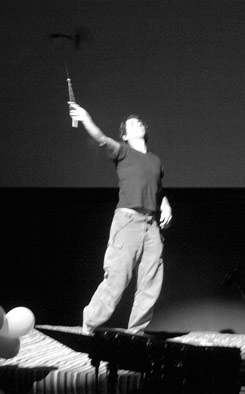
Mextoys: a toy in-between
Within this
conceptual framework,
Mextoys operates as both a
compositional strategy and a
critical reflection on
perception, agency, and
automation. Objects, toys,
performers, and audiovisual
media are not treated as inert
materials, but as entities
endowed with a form of agency
through projection, interaction,
and repetition. The work thus
explores the unstable boundary
between the human and the
artificial, revealing how
mechanization is not imposed
solely from the outside, but
emerges from deeply rooted
cognitive and cultural
structures. |