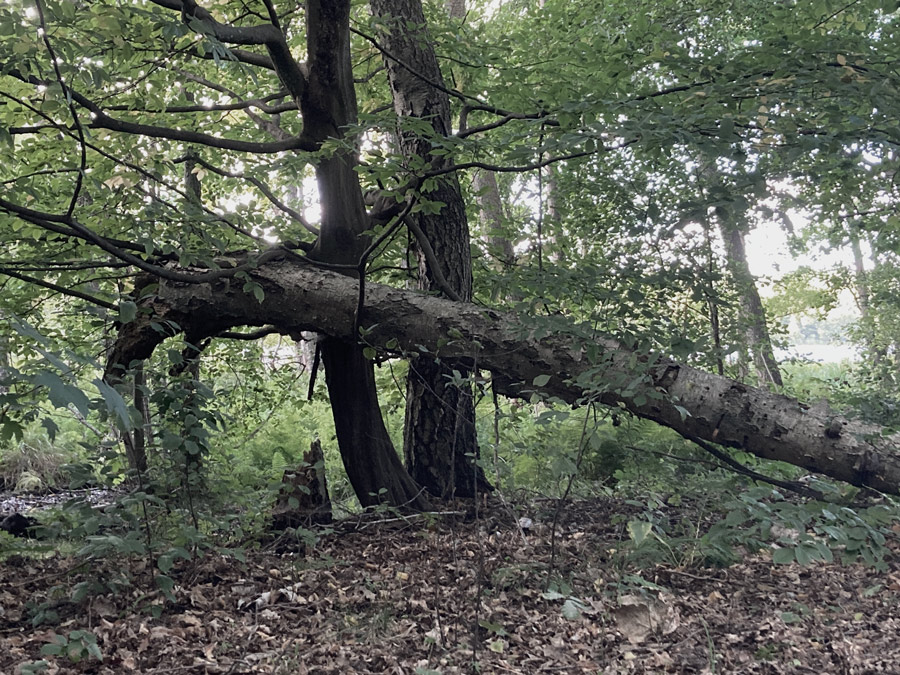
In this essay, I describe a perceptual condition essential to me, which has given rise, since the eighties, to much of my work. It is the basis of my theoretical framework: from it derive two pillars that I develop in separate essays, "Trembling Suspension" and "Field Logic." I do not intend to establish, here or there, a "general theory of perception," a "genesis of art," or a "lesson for young artists."
Specifically, I speak of objects and functions perceived as inseparable, but also of the different ways in which a function can be bound to an object. I use object in its broadest sense, always in the context of the artistic drive: object as a temporal notion, as an event, as an experience, as an entity (that is, something that can be identified, or that can define its own identity), as a displacement, and even as a subject: a person can also be the object in which a new function is constituted, without ceasing to be a subject. A function, on the other hand, is what an object or entity does, or what it serves for, within the larger system that contains it. The intrinsic function is the one bound to the object by its design, use, or symbolic value, whether perceptible or not. A tree, for example, has several intrinsic functions: ecological, economic, agricultural, and others. I will call invisible functions those intrinsic functions that, for a given perceiver, are not perceived. For instance, a tree's ecological functions may be visible to birds, while the agro-industrial functions of the same tree, once sawn into logs, may be invisible to them and perfectly visible to the timber industry.
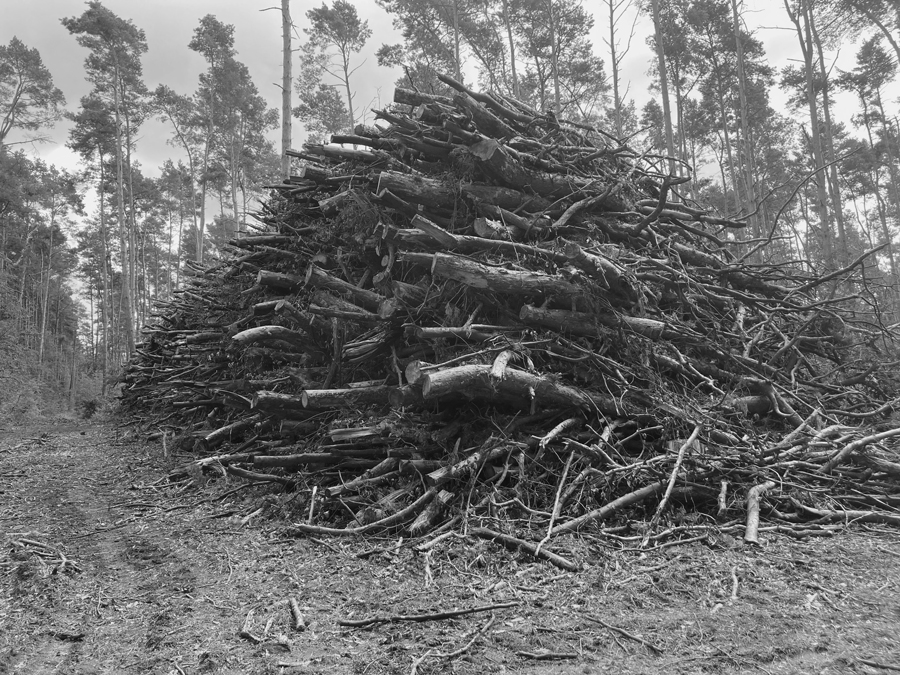
CS: REMAINS OF TREES, TREES FOR BIRDS, MÜNCHEBERG, GERMANY
We then have:
Object: invisible intrinsic function
I will call Hierarchical Perception (HP) the perception that recognizes an object only through its intrinsic function or functions, which cannot be separated from it.
An extrinsic function, by contrast, can coexist with the intrinsic functions and take in others that, apparently, bear no relation to the object. It is independent of the object's design, use, and symbolic value, but not of the object itself: it can appear only where the object actually sustains that functional possibility. It is therefore not a hidden function already belonging to the object, but a function that requires an extrinsic relation or configuration to become effective. I will call this extrinsic function Fuunction. I write this term, and those that follow, with a doubled letter to keep them within the field of the usual terms: function and Fuunction, time and Timme, object and Obbject. Which letter is doubled in each case responds only to visibility: making the term stand out at first sight from the usual one. They are not separate categories: they interact, and the latter derive from the former. A name such as "metafunction" would have suggested a superior category. Perception does not invent the Fuunction: it allows it to be recognized and revealed without canceling the intrinsic functions already bound to the object. I will call this perceptual condition Non-Hierarchical Perception (NHP). It is not a stable disposition: it appears and disappears, sometimes with no necessary relation to the will of the perceiver.
We then have:
Object: invisible intrinsic function
NHP → Object → Timme → extrinsic Fuunction A, extrinsic Fuunction B, extrinsic Fuunction C = Obbject
Under NHP, the object keeps the same intrinsic functions, but it can enter another ontological condition: the Object becomes an Obbject, and the function that appears becomes a Fuunction.
I use HP and NHP in my own sense, not as a description of a neural architecture: I do not claim that my brain processes without hierarchies, which would be indefensible; I describe an opening toward a different perceptual condition. Even if the brain processes information hierarchically, as some neuroscience models hold, one can enter a perceptual condition that imposes no prior hierarchies on the elements it encounters.
An example of that prior hierarchy: a painter in front of a landscape may decide, before really looking at it, that everything is ordered by perspective, and draw the vanishing lines before the first stroke. Another may let himself be carried by the elements he encounters, giving each one an identity of its own, even if it breaks the rules of perspective. Neither way of painting is, in itself, HP or NHP: Velázquez built Las Meninas with exact perspective, and I later try to perceive that work in NHP. The difference is not technique, but whether hierarchy precedes perception.
Time and Timme
Obbject and Fuunction do not arise instantly. There are still no I-glasses on sale that would let us scroll between the perceived world and encounters with Obbjects and their Fuunctions. NHP is a contemplative condition, one of deep observation. So, if the object does not immediately become an Obbject, what lies between the object and its Fuunction? There is a time that belongs neither to the object nor to the function, and that does not correspond to a calendar measure either. I will call it Timme. Timme is the interval in which a functional possibility has not yet become a Fuunction, and the object has not yet become an Obbject. In our chronos, that interval can last minutes or years, but we cannot locate the instant it ends: when the Fuunction appears, like a flash of lightning, the Timme vanishes.
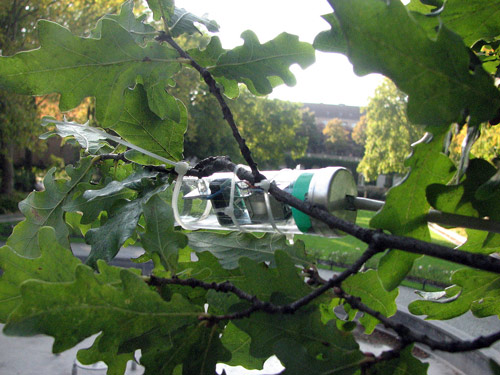
CS: ACCELEROMETER PLACED ON AN OAK BRANCH. THE TILT GROUP. BAUMBERAUSCHEN. KÖRNERPARK, BERLIN
Let us look at a case linked to my work. The same tree, the bird's tree, keeps its ecological and timber functions. Still, if sensors are placed at the tips of its branches, it can generate digital information from their movement, which in turn can trigger sound or, for example, feed data capable of modifying the water jets of a fountain in the city, so that the public tries to relate them to the intensity of the wind. It can also receive movement data from other trees fitted with sensors: it is then a tree and, at the same time, a networked creative instrument. The functions coexist without canceling each other. Sensors are not an intrinsic property of the tree: they form an extrinsic configuration through which a Fuunction appears, and the tree becomes an Obbject. In this case, the project took years, from the first observation of the tree moving in the wind to its technical and artistic completion, but those years are not the Timme. The trees with sensors really existed; what cannot be put on a calendar is the moment when that functional possibility came to be constituted as a Fuunction. That interval is the Timme of this specific arboreal ontology. It is not Bergson's durée: it does not describe the experience of a human consciousness living the same time differently. Between my first observation of that tree in Mexico and the completion of my trees-with-sensors project, years passed, along with dozens more observations. That span is mine and irrelevant. Timme, by contrast, is not mine: it is the interval in which the tree's functional possibility had not yet been constituted as a Fuunction, and it ends with an ontological "click," the spark in which the object acquires its Fuunction and becomes an Obbject.
I need Timme because, if I acknowledge that new functions can be constituted, I must be able to distinguish between a functional possibility and its effective constitution. Without that distinction, the Fuunction would seem to have always existed, or would appear as an instant consequence of an extrinsic configuration, and neither option describes what happened with the tree. There is an interval in which a functional possibility can exist without yet having been constituted as a Fuunction. Timme names that interval, and we can only recognize it afterward, when the click happens: a tree can be observed for years without ever becoming an Obbject. It is not a general theory of time, but what I need to describe the appearance of a function that was not previously constituted as a Fuunction.
NHP is not a transcendental state of perception. An Obbject is not "revealed" to me as in a hallucination: I perceive in NHP, a condition that is neither homogeneous nor regulated, and therefore hard to describe rationally. NHP does not illuminate me: it barely lets me see, like a trembling candle in a dark room, something I did not see before. With reason and craft I build what turns it into a work. Thus I can describe each Obbject both as a perceptual experience and as a constructive process bound to that perception: from observing a tree moving in the wind, through years of technical and artistic development, until the network worked. And there the Timme vanished. I suppose this is not exclusive to my work, because what any artist dreams or hallucinates, however fanciful, requires a conscious, rational, constructive process to materialize. Inspiration and the muses are the romantic way of naming what arrives unasked, but that myth ignores two things. One: it places the origin outside (the "muse" dictates to the artist). In NHP, nothing is dictated: there is a possibility that the object really sustains and that perception reveals. And two: it implies the work arrives "ready-made," when in fact, after seeing, reason and craft come, sometimes for years.
As far as I know, hardly anyone talks about this today. In contemporary art, the origin of a work is usually conceived as the result of research, a concept, an idea (or an ideology), a response to a call for artists, or a curatorial relationship. I do not know whether artists stopped perceiving or only stopped saying so, because the system that "selects" us asks for projects, not perceptions. Or it may be my own lag. Art has changed a great deal in its ontologies, theories, and tools; the coherence of my work, by contrast, seems to have held since the eighties. That "seems" raises the question, and this website is my answer, for now.
The Rorschach Blanket
Two functions alone are not enough to generate two existences. A blanket keeps you warm and covers you from the rain; a fork is for eating or for popping a balloon. In both cases, the second function is contained in the object's physical design properties (insulating from cold and water, piercing), without any perceptual disposition having to reveal a new functional possibility. The Fuunction, by contrast, does not derive from the object's design, use, or symbolic value: it requires an extrinsic configuration that turns a possibility the object can sustain into an effective one. In the case of the tree, that configuration is the sensor placed at the tip of a branch. Only then, after a Timme, does the object become an Obbject.
The hardest case is a steel barrel adapted as a table for eating standing up: a round wooden board on top; below, it is still a barrel. It looks like a Fuunction, but it is not. Being a table extends the properties the barrel was designed for (it is rigid, stable, stands upright, and its lid already bears weight), and its "industrial character" comes from what the barrel signifies. Both depend on its design and its symbolic value. Moreover, the two identities do not remain in suspension: they resolve into a single one, an "industrial table," in which the barrel becomes the table's style. The same kind of barrel appears in one of my first pieces, Huge Mobiles (1987): construction rods inside oil barrels that sound by gravity alone, with a simple push. It is a property its design ignores, made effective by an extrinsic configuration. There, barrel and instrument hold at once, without one becoming an attribute of the other.
Pareidolia is a different case: as in the Rorschach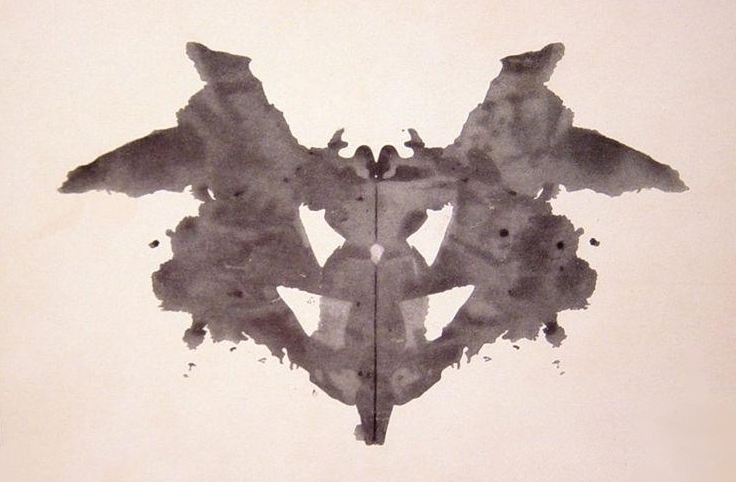 Plate I, Rorschach test (1921). Ten symmetrical inkblots; what each person "sees" in them is analyzed psychologically. No shape is objectively there: the viewer projects it. test, it discovers no new function of the object. The perceiver projects a known pattern onto a configuration that admits that projection, but the object does not thereby acquire a corresponding function. The brain acts here as a scanner of assimilated patterns: it connects what is perceived with one or more already known objects. A bollard found in the street (photo, right) works differently: someone traced its shadow with white paint, and since then, while it remains a bollard, it is also a sundial and an observatory, as well as a piece of street art. Unlike pareidolia, the sundial and the observatory are not invented by the viewer; they exist and can be verified, whether or not anyone perceives them.

SUSANA MENDOZA, FOUND OBJECT, MEXICO, CA. 1992
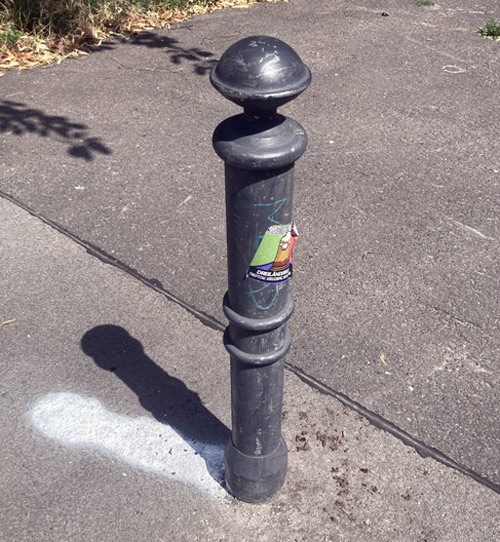
CS: STREET ART, BERLIN, 2026
The constellation of Obbject, Timme, and Fuunction has given rise to almost all my works, from the score-based pieces to my drawings, videos, photography, and automata. In designing a work's production, I have always intended to lead the public toward a perceptual experience similar to that seminal perception. Not toward a personal reading or interpretation, of course, but toward a perceptual state "prior" to the work. Unlike Robert Morris, for whom meaning is built in the relation between work and viewer, I prefer to try to seduce the viewer toward the perceptual condition that preceded the work, then leave them alone with their interpretations. One could object that inducing a perceptual condition already directs attention and therefore imposes a hierarchy. But every work frames attention; NHP rejects not the frame, but the idea that something within it decides in advance what matters most. And since that condition appears and disappears, sometimes with no relation to the will, no work can guarantee it: it can only create the conditions for it to happen.
This condition has two consequences, which I would even dare to call ontologies:
When it appears before an object, NHP does not strip it of its intrinsic functions: it adds a simultaneous Fuunction and, therefore, another existence. The object becomes an Obbject precisely at that instant, when the Timme vanishes. No function prevails over the others: the existences coexist without resolving into one. If a work is born from this perception, it can induce a similar state in whoever looks at it: the perception of two or more simultaneous existences. I call this Trembling Suspension, which I develop in more detail in its own essay.
When, instead, it appears before an already existing group of entities perceived simultaneously and related to one another (whether experiences, situations, beings, or objects), none prevails over the others: from those very relations, without a center, a general coherence emerges, as in a healthy ecology, where no organism directs the whole and yet the system holds. I call this non-gravitational system Field Logic, which I also develop in its own essay.
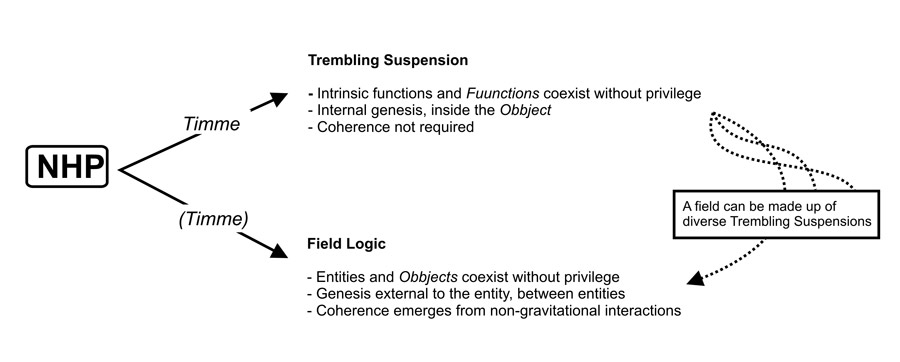
A field, then, does not exclude Trembling Suspension: it can be made up of several Obbjects, each sustaining its own simultaneous existences, without the internal coexistence of each Obbject interfering with the coherence of the field — a field of Trembling Suspensions. The tree with sensors is already such a case: an Obbject in Trembling Suspension (ecological, timber, and networked instrument at once) and, at the same time, part of a network of trees where none dominates the others.
How It Happens to Me
Out of nowhere, at any moment, I come across a situation, an object, a person, a particular event. I register it for no apparent reason, that is, "it happens to me," and it stays in my memory not as something learned, but as something apprehended. Some time later, a time I do not register, another situation appears to me, finds me. Rarely does a connection form between the two, but sometimes it does, and that link is apprehended in turn. Later the realization arises. For La Pasión según la Gente (2001), for instance, I recorded a massive Holy Week celebration in a small town in Mexico for about three years. After each session I came home, covered my eyes with a black sleep mask, and listened to the recordings with headphones. Around that same time I wondered what the technical name was for what lets us hear, in a film, a distant conversation on a beach. The name was "sound perspective." Months later, listening to the recordings again, the connection happened on its own, and sound perspective became one of the techniques of the work. And La Pasión arose: not as an idea, but as a process in which the unpredictable, the relational, and the conscious mix. Many of my later pieces arose in a similar way, each in its own manner: Mextoys, Teleprompter, Maquina Latina, The Body of Ligia, Antilegos, and Se fueron los pájaros, which, as I told in a 2016 interview , was born when the acoustic descriptions for the deaf from the series Breaking Bad met a recording of some fishermen chatting in a boat.
Registering or encoding the event preserves the original encounter's charge, no matter how long it takes to resolve. Without that encoding, memory loses the record entirely, or turns it into something else, losing, in either case, the momentum of the original encounter. That encoding, moreover, is not always resolved only once: sometimes it remains latent, and what was archived sprouts again: a record already used, apparently closed, resurfaces years later, rediscovered in a different light, as if the archive itself kept a surplus of meaning that the first reading did not exhaust. In the same interview, I put it this way: "the digitization of the analog has allowed me to recover the visual from experience, since all my notes and observations are digitized and later observed outside the context of sublimation, perception, or introspection. This allows me to juggle the materials arbitrarily and adapt them at will to create a work that surprises me."
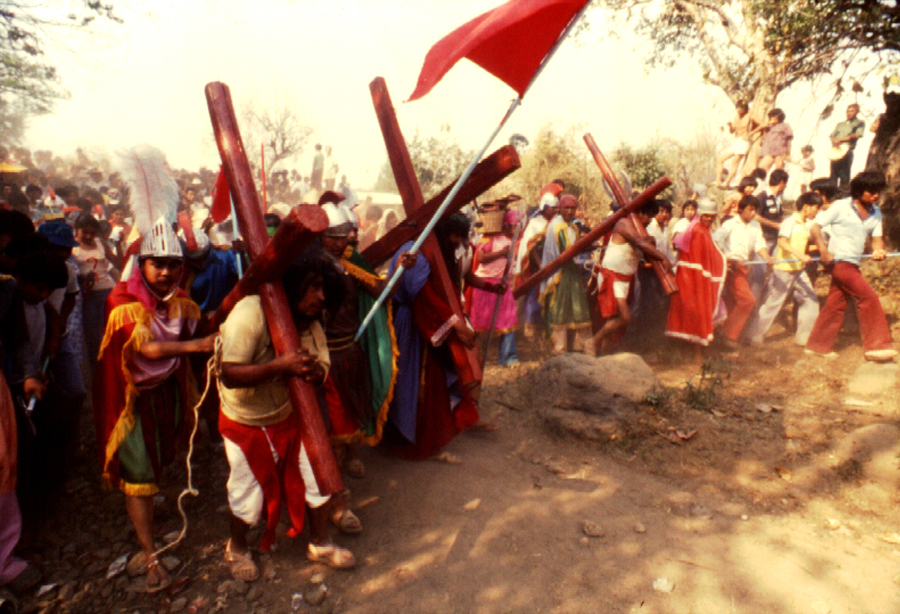
MIGUEL RODRÍGUEZ, THE PASSION OF CHRIST IN OCOTEPEC, MEXICO, 1997
In La Pasión según la Gente, I set aside the intrinsic functions of the procession, religious and anthropological, and suddenly it appeared to me as a historical dislocation: as if it were the actual day of the crucifixion, which I imagine as a popular festival, with vendors, children, and music. That is the Fuunction. The "actor" carrying the cross, a poor and devout peasant, is at once a Mexican peasant and Jesus himself, in Trembling Suspension, for me and for the people. And the sound of the street, with its voices, its bands, and its vendors, is a field: no sound organizes the others, and all of them are coherent with one another. Then came intense community work and the scores, which were performed live together with the recordings, sometimes synchronized with them. With La Pasión, drives that had been mere intuitions in Huge Mobiles and Mandarino Marioneta were confirmed: there I saw how something I could not yet see clearly could become real, something that only now, decades later, I can name, describe, organize, and present. Years later, in Mextoys (2003–04), I used part of a video I had shot during La Pasión, but in another context and for different purposes. I did not "learn" in one work what I "applied" in another: I returned to the same condition from another encounter. What is constant over forty years, then, is not knowledge acquired in a linear way, but a perceptual condition. This essay was written to describe it, not to tell what each work "taught" me, but to name, looking back, what made them all possible. My works do not form a sequence; they coexist, as in a field. That is why they are not arranged chronologically on this website.
Examples: Works by Others in NHP
The following examples operate in a nested way: I observe other artists' work with my own NHP, as a viewer, and that same observation makes me suspect, without any way to prove it, that those works were also made from the makers' own NHP. I do not seek to demonstrate how Bresson, or Velázquez, or anyone else really perceived; I seek to offer a reasonably clear picture of how I myself live NHP, both when looking and when creating.
Bresson

HENRI CARTIER-BRESSON, BEHIND THE GARE SAINT-LAZARE, PARIS, 1932.
In 1932, Henri Cartier-Bresson photographed a man leaping over a puddle behind the Gare Saint-Lazare, in Paris. The image became famous for its geometry (the perfect reflection, the foot a millimeter above the water). It became the emblem of his notion of the moment décisif: the simultaneous recognition, in a fraction of a second, of an event's significance and the precise organization of forms that express it. But another silhouette stands in the background, its back turned, crossed by a railing, on it or behind it, slightly out of focus, perhaps about to turn into one of those squat columns in front of it. It plays no relevant role in the foreground geometry or the captured movement. To perceive this image in NHP means refusing the fame of the moment décisif any automatic authority to decide what is relevant in the frame: the leap has, in advance, no more ontological weight than the silhouette back there. Both sustain the same photograph, without one subordinating the other. I call that figure, an entity in absolute solitude, a "Lost Soul": a condition to which the composition assigns no function; it is, rather, an antifunction. It is not that something acquires a Fuunction (as in the example of the bollard, further on); it is that an entity in the frame reveals itself without any use.
The Bollard
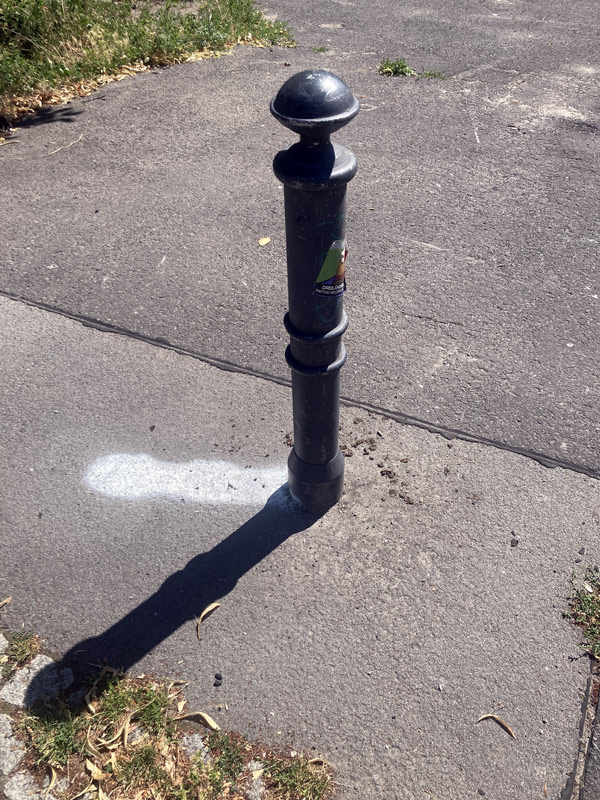
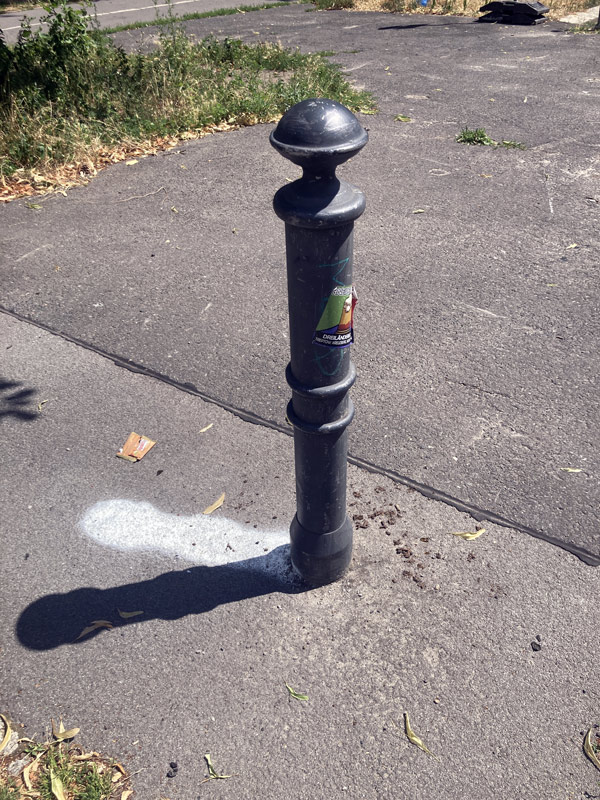

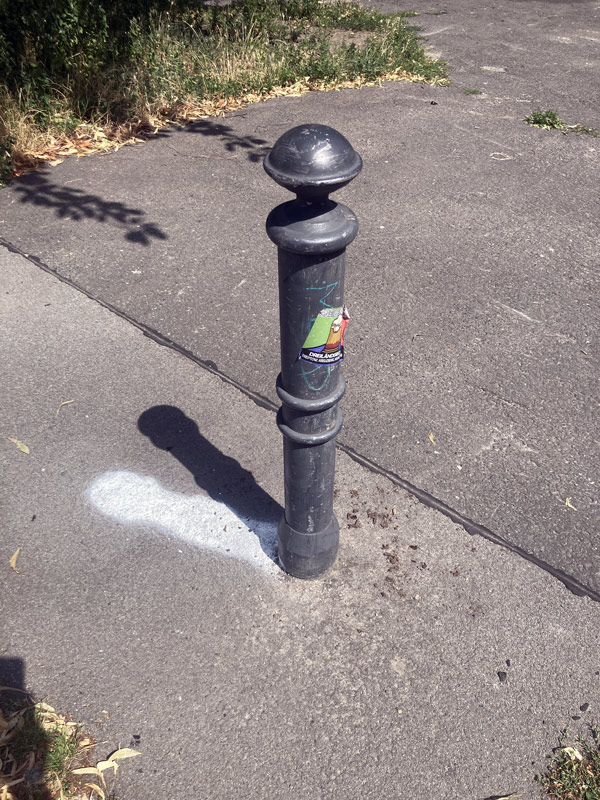

FOUND PIECE, BERLIN KREUZBERG, 2026.
It already appeared at the beginning of this essay, set against pareidolia: a bollard whose shadow someone traced with white paint. That tracing is a street-art intervention, and it is also the extrinsic configuration that makes two Fuunctions effective: a sundial, because the shadow coincides with the tracing only at a certain hour, and an observatory, because that exact coincidence happens only on certain dates of the year. In Xochicalco there is, quite literally, an inverted bollard: a shaft that pierces the roof of a cave and lets the sun in to mark its passage through the zenith, twice a year. On the bollard, the white paint does the work of that shaft. All this without the bollard ceasing to hold back cars. I return to it here as the simplest case: a single Obbject, several existences, none canceling the others.
Morocoy
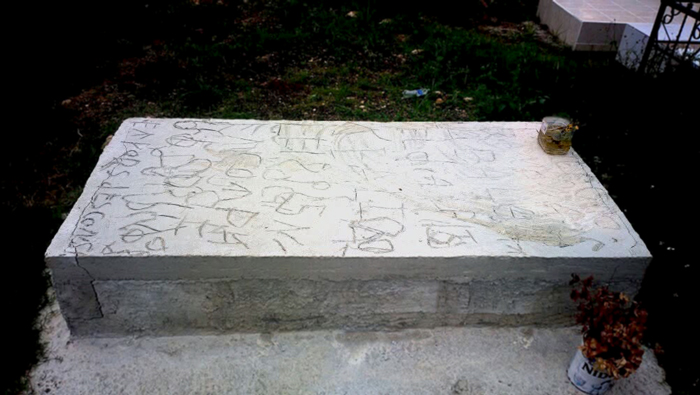
CS: CEMETERY OF MOROCOY, SOUTH QUINTANA ROO, MEXICO
The Morocoy grave, which I develop in more detail in Trembling Suspension, is the first case in this essay in which Trembling Suspension and the Lost Soul appear together. In a rural cemetery in southern Quintana Roo, someone traced a gesture of writing with a finger on the fresh cement, without forming a single legible word. The headstone keeps its function: it marks a grave and tries to name whoever lies beneath. But its illegibility adds another existence: the most exact representation of what happens to a biological being when it disappears, which is to become illegible. While a legible headstone "tells us" that someone is still there, this one tells the truth without meaning to. Thus the intention to name and the failure of that attempt share the same ontological weight, without the context of a graveyard imposing a resolved reading on either: that places us in Trembling Suspension before the grave. And whoever lies beneath is a Lost Soul, in absolute solitude, without a name, without a function, without a cemetery.
Las Meninas
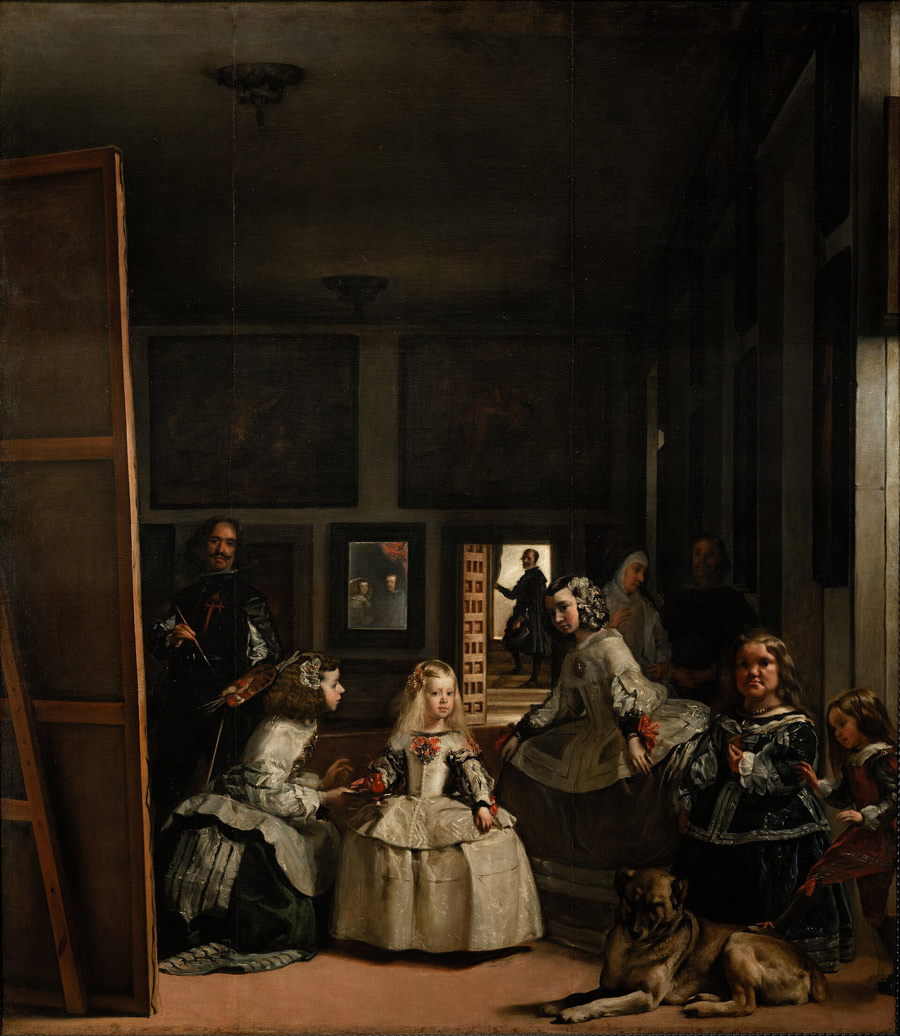
DIEGO VELÁZQUEZ, LAS MENINAS, 1656, MUSEO DEL PRADO.
Las Meninas (Velázquez, 1656) is, among the examples in this essay, the one that lets me take NHP furthest, toward invisibility: it not only reveals Obbjects and Fuunctions, but places me on a plane where I share various aspects of the invisible, each with its own logic. That is why I have left out the Lacanian psychoanalytic aspects, the geometry of gazes, the analysis of objects, and the monarchic hierarchies. Mine is a deliberate, almost suicidal exercise: applying Obbject, Fuunction, and Timme to the most analyzed painting in history. The best-known reading of the painting, Foucault's in 1966, follows a different method and interpretation: for the French philosopher, the represented crosses over into the real. The oil-painted light illuminates the viewer, whom the represented Velázquez "sees," and the painted figure in the doorway "assumes" his "function." Foucault describes these crossings in almost literary language, without defining in what sense the represented acts upon the real. I separate the two planes precisely so as not to confuse them: the painting does not illuminate, does not look, and does not replace anyone outside it. My path is different: to perceive a complex work of art in NHP. The reader can decide whether my reading survives my methodology.
Meninas: Two Ontological Categories and Three Invisibilities
To keep our bearings, it helps to fix two spaces. The first is real: the area of about five square meters in front of the painting, from where it is viewed, wherever the painting may be. Today it is in a room at the Museo del Prado; in 1656, Velázquez painted it in the Cuarto del Príncipe (the Prince's Quarters). I will call it eFRONT (the space in FRONT of the painting). The second is the space represented in the painting: the Alcázar room with the Infanta, the maids of honor, the dog, the painter, the mirror, and the door at the back. I will call it eREP (REPresented space). Unlike eFRONT, eREP is not really a space: it is a painted surface of about nine square meters that represents a room that did exist, the so-called Cuarto del Príncipe in the Alcázar of Madrid, destroyed in the fire of 1734. Its floor stands at no real height: it is painted on a strip of canvas hanging above the Prado floor. It is a represented space that "floats" above the place where the public stands.
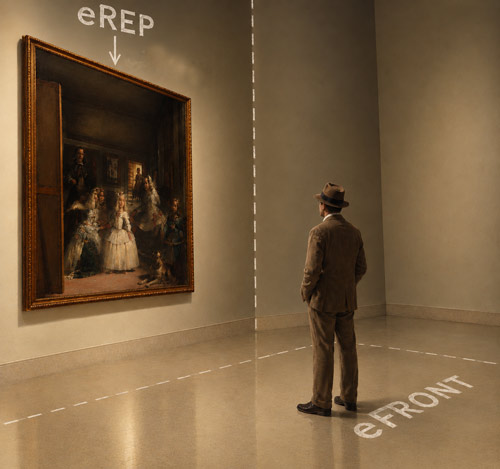 1
eREP, eFRONT: TWO ONTOLOGICAL CATEGORIES
Illustration generated with AI: no original documentation
‘I can’t believe I’m in front of this masterpiece again.’
Between these two spaces, the Fuunction is constituted differently than in the bollard. The sundial is verified by the sun, even if no one perceives it; here, what is constituted is a perceptual Fuunction: a presence in eFRONT that exists only in perception, and does not amount to anyone being physically there. It is not the figure that leaves the painting: it is the notion that floats toward eFRONT, and it does so through an association grounded in what the painting shows, with its perspective, its mirror, and the gazes of its figures. That is why the experience does not depend on an exclusively personal association: the painting's configuration allows other viewers to perceive those presences too. What NHP adds is sustaining them at once, without one erasing another, and recognizing the viewer's place among them.
Every painter is, of course, absent from the paintings he painted, but what distinguishes Las Meninas is that the painter himself is represented, painting, brush in hand, next to the canvas he is painting. His presence distills toward eFRONT, and prompts another thought in me:
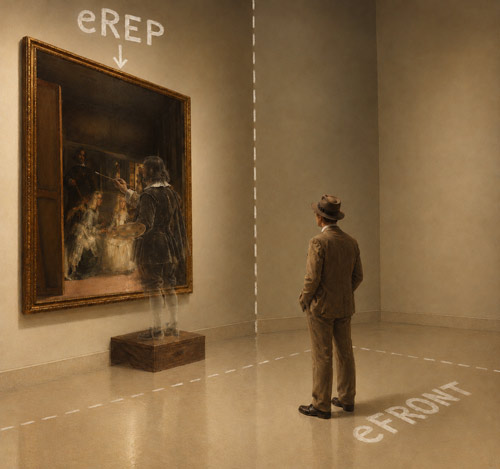 2
CHRONOLOGICAL INVISIBILITY
Illustration generated with AI: no original documentation
‘I am sharing the space with one of the greatest painters in history, at the moment he was painting this picture. The real Velázquez stood in front of this canvas, with his palette, in another time and in another room, in the place I now occupy.’
In this first invisibility, the chronological one, the object is the represented Velázquez. Its intrinsic function is to represent the painter at his craft in two dimensions. NHP can be triggered by the context of similar objects and actions: the two-dimensional is identified with the three-dimensional through shared components, the stretcher, the act of painting, and the author. I see the painting; I see the represented figure painting; I know he is the author of the canvas in front of me. The extrinsic condition is me, in eFRONT, in front of that figure. The Timme vanishes when I spontaneously lean my head in (stretching my neck, physically or mentally) to see whether Velázquez might "also be there." What appears then is the Fuunction: making eFRONT the place of the real painter, next to me. The represented Velázquez becomes an Obbject: a figure painted in eREP and a presence in eFRONT. His two existences hold without resolving, in Trembling Suspension. I do not see him, and I keep looking at the painting (the dog, the girls, the dwarfs, Velázquez's hand with the brush, blurred, in motion). Everything in the scene is being painted, and everything brings me back, like a magnet, to the act of painting. That is why the presence does not go away: the painter is and is not there, at once, painting next to me.
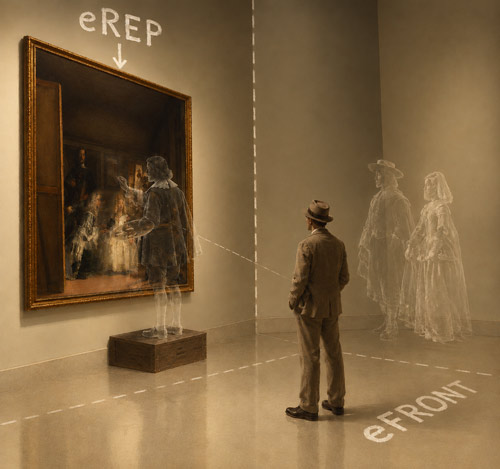 3
FICTIONAL INVISIBILITY
Illustration generated with AI: no original documentation
‘I had never stood next to the monarchs. Since they are reflected in that mirror in the painting, they must be in front of the painter, and if they are posing for him, they must be beside me. I don’t dare turn toward them: people will think I’m crazy. But I’m sure: their place coincides with mine.’
In this second invisibility, the fictional one, the object is the monarchs' image in the mirror. Its intrinsic function is to represent the reflection of the models posing outside the scene. NHP can be triggered by the context of similar objects and actions: the mirror shows what is in front of it, the represented painter looks that way, and whoever is posing for him must be there, looking at the scene. That is why, when I look at the mirror and see the painter painting, I know someone is posing. The extrinsic condition is me, in eFRONT, in a place "shared" with the monarchs. The Timme? It vanishes when I feel the urge to turn toward them and dare not. What appears then is the Fuunction: distilling the monarchs into my eFRONT. The image in the mirror becomes an Obbject: a reflection painted in eREP and a presence in eFRONT. But the fact that the mirror plays a role here does not make the first invisibility disappear: that would be perceiving hierarchically. The painter is still there, elsewhere in eFRONT, next to the canvas, and the two presences overlap and hold without resolving, with the same weight, in Trembling Suspension, like a perceptual mist. I keep looking at the painting, which pushes me, like a magnet repelling another, toward the monarchs and the painter, next to me. That is why the presences do not go away: the monarchs and Velázquez are and are not there, at once.
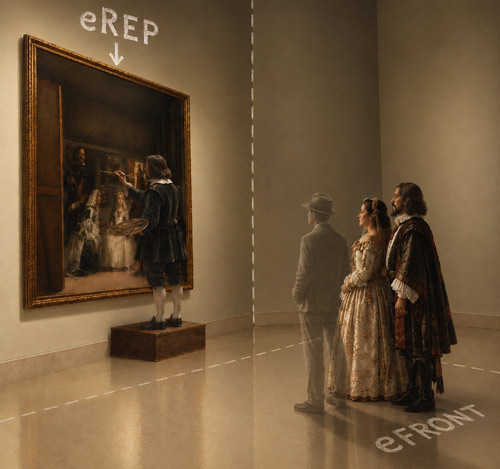 4
PARADOXICAL INVISIBILITY
Illustration generated with AI: no original documentation
‘I am standing here, next to the monarchs. I see my shadow on the museum floor. I exist. And yet the monarchs do not see me. The Velázquez who painted Las Meninas does not see me. Nor does the Velázquez represented in the painting. I do not see myself in that damned mirror. Am I perhaps hidden in that dark matter surrounding the monarchs? But my shadow is here, on the floor, I see it, it is stuck to me: I exist.’
In this third invisibility, the paradoxical one, the invisible one is me. A represented mirror does not reflect: it is only part of eREP. In it, I do not exist. In NHP, however, I perceive it as a place: the painting points to where I am, shows the reflection of the monarchs standing next to me, but not mine. At the same time, the represented figures do not perceive me, because they do not see: they exist only for me, as Obbjects. I am invisible to the invisible. The first two invisibilities, the chronological and the fictional, overlap in my perception. The painter and the monarchs keep their two existences as entities, painted and translucent, suspended, trembling, between them. Not me. The only evidence of my existence as an entity is my shadow. And here lies the paradox: of the three presences in that place, mine is the only real one (I paid my ticket to get in) and the only one that appears nowhere: neither painted, like the Velázquez on the canvas, nor reflected, like the monarchs. My solitude arises from their invisibilities: surrounded by presences that exist only in my perception, and in which I have no place. I am a Lost Soul, in absolute solitude: a condition to which this constellation assigns no function at all. An antifunction. An entity that reveals itself without any use.
Antecedents
Although this essay mentions historical antecedents and tendencies, it aims neither to build a genealogy nor to justify NHP's validity by its precedents; these references only show that the question has appeared independently in different contexts. The central aim remains to describe NHP as a phenomenon, as the mother experience from which Field Logic, Trembling Suspension, and the Lost Souls derive.
In the Qiwulun chapter of the Zhuangzi (China, 4th century BCE), we find an early relativization of privileged positions: read from our perspective, the text suggests that nothing is granted in advance a privileged place as the origin or explanation of the rest, and that apparent hierarchies are only the effect of a limited point of view.
India develops, centuries later, its own internal debate on the structure of perception: the Nyāya school generally describes it as a sequential two-stage process, first non-conceptual and then conceptual; the Buddhist epistemology of Dignāga and Dharmakīrti defines perception as free of all conceptual construction, leaving concepts to inference; Advaita Vedānta also admits a non-conceptual perception, though for its own reasons; and the Grammarians, with Bhartṛhari, deny that any cognition exists without language.
In Iran, Suhrawardi (12th century) and later Mulla Sadra propose explicitly hierarchical and graded models: being and knowledge organized in degrees of light or intensity. James Maffie, in his contemporary philosophical reconstruction of the Mexica worldview, interprets teotl, a dynamic and interconnected energy, as explicitly non-hierarchical. In Japan, Nishida Kitarō calls "pure experience" the mode of consciousness prior to the subject-object split; read from here, it is experiencing facts just as they are, before judgment intervenes.
In 1917, in Russia, Viktor Shklovsky proposes in "Art as Technique" that art exists to break perceptual automatization: habitual perception reduces objects to something already recognized, "algebrized" (we see them, but no longer perceive them); art returns them to strangeness, forcing us to perceive them anew. Shklovsky anticipates the diagnosis, not the remedy: his automatization resembles what I call HP, but his estrangement is an effect the artist builds into the work, whereas NHP is not an effect of the work: it is a condition of perception, of whoever makes the work or whoever looks at it.
The modern science of perception, which emerged in Europe in the 19th century, enters this discussion from a hierarchical perspective. Hermann von Helmholtz proposes that perception actively interprets incomplete signals through acquired knowledge: the notion of unconscious inference. An explicit hierarchical architecture arrives more than a century later: Rao and Ballard (1999) propose a neurocomputational model in which descending connections carry predictions, and ascending ones carry the error between that prediction and the actual signal; Karl Friston later generalizes this scheme in the free-energy principle. This framework is among the most influential in neuroscience, though not a settled consensus. Against the inferential tradition, in the United States, James J. Gibson had proposed an ecological approach: relevant information is already structured in the direct relation between organism and environment, available without any need for internal reconstruction. Gibson called affordances the possibilities for action that an environment offers an organism. The Fuunction is not one of them: an affordance is already available in the relation between organism and environment, whether perceived or not, whereas the Fuunction requires an extrinsic configuration to be constituted.
The discussion about the relation between an object and its functions has respectable philosophical precedents. Kant, in the Critique of Judgment (1790), already separates an object's form from its usefulness: the beautiful is "purposiveness without purpose," contemplated with function set aside. Wittgenstein formulates it as aspect perception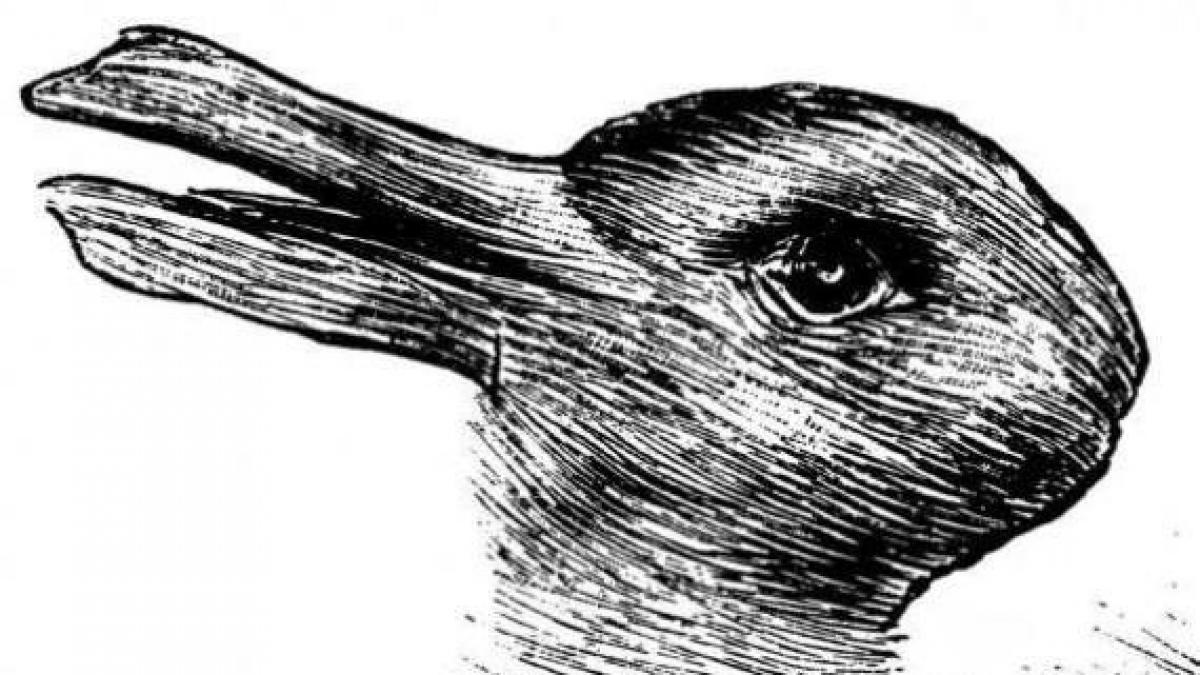 The same drawing can be seen as a duck or as a rabbit, without the drawing itself changing at all. Wittgenstein calls that change the "lighting up" of an aspect (Aufleuchten eines Aspekts, which Anscombe translated as "dawning"; Philosophical Investigations, Part II).. Heidegger, and later Bill Brown, describe something related from the opposite direction: an object reveals itself as a "thing"Not just as a functional object, at the moment it stops serving its usual function: it breaks, fails, is misread ("Thing Theory," Bill Brown, 2001, taking up Heidegger's object/thing distinction)., not just as a functional object. NHP differs from all three in one structural point: it does not subtract function to reveal something behind it (Kant, Brown), nor does it present two mutually exclusive readings (Wittgenstein). It adds a Fuunction without canceling the intrinsic functions, and all of them can hold at once in Trembling Suspension. The general question is not new; what is new is the Fuunction as something constituted through an extrinsic configuration, the Timme of that constitution, and the fact that this condition has sustained forty years of artistic practice.
Timme also has philosophical neighbors. Aristotle distinguishes between potentiality and actuality, though for him potentiality is internal to the thing (the acorn already contains the oak), whereas the Fuunction requires an extrinsic configuration. Maffie reads the Mexica teotl as process and becoming. Neither is the origin of Timme; they only show that the question of the passage between possibility and constitution has a long history.
However, one thinker with whom my experience bears a closer kinship is Alfred North Whitehead. For him, reality is not made of stable substances, but of occasions that become and perish; there is, he says, no continuity of becoming, but a becoming of continuity. NHP behaves similarly: it is not a permanent disposition, but a condition that appears and disappears in episodes. For Whitehead, moreover, the subject does not exist before its experience but is constituted in it, and what perishes does not disappear entirely: it becomes a datum taken up by future occasions. Something similar happens with my records: they remain apprehended, latent, and years later they enter a new encounter. One should not, however, confuse the terms. Whitehead calls those momentary occasions "actual entities," much more elementary than what I call an entity: something that can be identified or that can define its own identity. The kinship lies in becoming, not in vocabulary.
I do not claim that these traditions, separated by centuries, geographies, and radically different philosophical languages, discussed the same problem in the same terms, nor that one position is the correct one. I only note that the question of whether perception must be organized hierarchically, or whether it can sustain multiple conditions without subordinating some to others, has occupied thinkers from almost every part of the world, in different directions, for more than two thousand years.
Bibliography
On the Author's Work
• Guillermo García Pérez. "Un antipaisaje sonoro." La Tempestad, September 8, 2016.
Object, Thing, and Aspect
• Ludwig Wittgenstein. Philosophical Investigations, Part II, section xi. Translated by G. E. M. Anscombe. Blackwell, Oxford, 1953 (original: Philosophische Untersuchungen, 1953).
• Martin Heidegger. "The Thing." In Poetry, Language, Thought. Translated by Albert Hofstadter. Harper & Row, New York, 1971 (original: "Das Ding," 1950).
• Bill Brown. "Thing Theory." Critical Inquiry, vol. 28, no. 1, 2001.
• Robert Morris. "Some Notes on the Phenomenology of Making: The Search for the Motivated." Artforum, April 1970.
Perception Across Traditions
• Zhuangzi. "Qiwulun" (Discussion on the Equality of Things), chapter 2. In Chuang Tzu: The Seven Inner Chapters, translated by A. C. Graham. Hackett Publishing, Indianapolis, 2001.
• Stanford Encyclopedia of Philosophy. "Perceptual Experience and Concepts in Classical Indian Philosophy." Spring 2025 Edition, plato.stanford.edu.
• Suhrawardi, Shihab al-Din. The Philosophy of Illumination (Hikmat al-Ishraq). Translated by John Walbridge and Hossein Ziai. Brigham Young University Press, Provo, 1999.
• Mulla Sadra. The Wisdom of the Throne (al-Hikmah al-'Arshiyyah). Translated by James Winston Morris. Princeton University Press, Princeton, 1981.
• James Maffie. Aztec Philosophy: Understanding a World in Motion. University Press of Colorado, Boulder, 2014.
• Nishida Kitaro. An Inquiry into the Good (Zen no Kenkyu). Translated by Masao Abe and Christopher Ives. Yale University Press, New Haven, 1990 (original 1911).
Hierarchical and Predictive Models
• Hermann von Helmholtz. Treatise on Physiological Optics, vol. 3. Translated by James P. C. Southall. Optical Society of America, Rochester, 1925 (original 1867).
• Rajesh P. N. Rao and Dana H. Ballard. "Predictive Coding in the Visual Cortex: A Functional Interpretation of Some Extra-Classical Receptive-Field Effects." Nature Neuroscience, vol. 2, no. 1, 1999, pp. 79–87.
• Karl Friston. "The Free-Energy Principle: A Unified Brain Theory?" Nature Reviews Neuroscience, vol. 11, 2010, pp. 127–138.
Direct and Ecological Perception
• James J. Gibson. The Ecological Approach to Visual Perception. Houghton Mifflin, Boston, 1979.
Time and Becoming
• Aristotle. Metaphysics, Book IX.
• Henri Bergson. Time and Free Will: An Essay on the Immediate Data of Consciousness (1889).
• Alfred North Whitehead. Process and Reality (1929).
Philosophy of Art
• Immanuel Kant. Critique of Judgment. Translated by Werner S. Pluhar. Hackett, Indianapolis, 1987 (original: Kritik der Urteilskraft, 1790).
• Michel Foucault. The Order of Things: An Archaeology of the Human Sciences (1966). Pantheon Books, New York, 1970. Chapter 1, "Las Meninas."
• Viktor Shklovsky. "Art as Technique" (1917). In Russian Formalist Criticism: Four Essays, translated by Lee T. Lemon and Marion J. Reis, University of Nebraska Press, Lincoln, 1965.