The pre-score is the recorded shape of a failure — designed in advance, accepted in full.
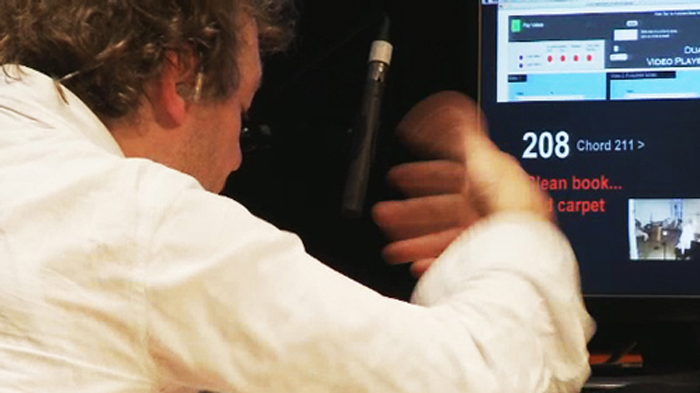
Máquina Latina is built on nested, Matryoshka-style metronomic inaccuracies. A first performer plays alone for one hour, governed by an accelerating metronome. The instruction is domestic and psychological: he is at home, trying to live — reading, eating, doing yoga — while the clock accelerates and the instrument keeps calling him back. The score is not designed to be executed correctly. The accelerating metronome guarantees failure. What the performer agrees to is not a performance but a controlled collapse.
These recorded human inaccuracies are used to generate a second metronome — the one the live stage performer will follow. His performance generates further inaccuracies on top of those. The first recording is simultaneously compressed from one hour to fourteen minutes, producing a stop-motion double: the same performer accelerated into something that no longer looks entirely human — not through pitch transposition but through extreme temporal compression, a Stop Motion Synthesis that amplifies every irregularity into a new kind of sound. I stopped the nesting process at two layers. It could continue indefinitely, until the accumulated human error fully dissolves any remaining sense of metronomic accuracy.
On stage, the live performer follows his own prior failure while his stop-motion double runs on the screen behind him. What Decision Field Theory describes as the speed-accuracy tradeoff operates throughout: as the tempo accelerates, the performer's cognitive and motor responses diverge from what any statistical model would predict — not through randomness but through irreducibly human cognition. No machine fully absorbs it. That is precisely what the piece is made of.
Who is the machine? The double on screen — mechanical, compressed, precise in its repetition — is built entirely from human imprecision. The live performer — breathing, hesitating, responding — is executing a score generated by a machine process, following failures he did not experience but inherited. The more you look, the less stable the distinction becomes.
This is Field Logic as temporal recursion: each layer feeds the next, no layer fully controls the result, the global form emerging from accumulated inaccuracy. The machine is made of human failure. The human is governed by the machine that failure produced. Neither is separable from the other.